We have an active and growing lab and are always looking for more undergrads who are interested in the ocean, marine biota, and global biogeochemistry.

People
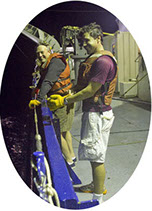
Dr. Mike Stukel
Mike is an associate professor at FSU. His research spans the intersection of plankton ecology and marine biogeochemistry. He has a love for all the zooplankton of the oceans and a passion for understanding how these microscopic organisms influence everything from the global climate to the local fisheries yield. Appendicularians are his favorite plankton. Unless it's ctenophores. Or salps. Perhaps phaeodarians, krill, Lingulodinium polyedrum, hyperiid amphipods, Tomopteris, or pyrosomes. It might be copepods. But he doesn't like chaetognaths. Contact: mstukel@fsu.edu
Grad Students
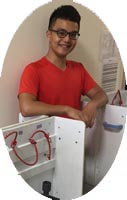
Tz-Chian Chen
Tz-Chian is a first year Ph.D. student who brings a love of zooplankton to FSU. He joined our lab after completing a Masters at National Taiwan University with Chih-hao Hsieh where he published a manuscript investigating copepod-induced trophic cascades. Tz-Chian is working with the CCE LTER program where his first project is focused on the effects of marine heatwaves across multiple trophic levels. Contact: tc22@fsu.edu

Jaehong Kim
Jaehong is conducting a numerical modeling study to investigate bottom-up ecosystem control related to the lobster fishery in Maine. His work is a component of a multi-disciplinary “Navigating the New Arctic” project that seeks to understand how melting glaciers and other effects of a warming Arctic will impact coastal human communities. Jaehong's work focuses on developing a model that links changing ocean circulation to nutrient supply, phytoplankton production, and the abundances of Calanus finmarchicus, an important North Atlantic copepod that is a key prey item of lobster larvae.
Mahnaz Sonia Islam
Mahnaz is working to understand the impacts of harmful algal blooms on fisheries of the West Florida Shelf. The dinoflagellate Karenia brevis is a harmful species that forms large prolonged blooms along Florida's Gulf Coast and produces a neurotoxin called brevetoxin. Karenia blooms can cause shellfish fisheries to be closed and, when in high concentrations, can even make beaches unsafe places for people to breathe. Mahnaz's work focuses on developing numerical simulations to predict the evolution of Karenia blooms.
Ali Appelgate
Ali is working with the California Current Ecosystem Long-Term Ecological Research program to understand the processes driving long-term change and ecological transitions off of the California coast. Ali's current research focuses on time-series analysis undertaken to understand the coherence in spatially resolved long-term time series of ocean physics, chemistry, phytoplankton, zooplankton, and fish. Ali seeks to understand the intersecting roles of top-down and bottom-up ecosystem processes and how these may vary in time and space.
Undergrads
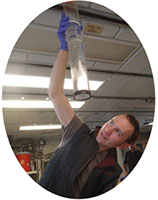
Maggie Johnson
Maggie is an undergraduate working in our lab. She has been working closely with Natalie Yingling and her research has focused on understanding phytoplankton dynamics in the Indian Ocean through epifluorescence microscopy.
Alumni
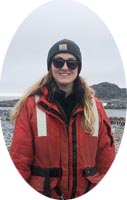
Natalie Yingling
Natalie completed her Ph.D. in 2024. Natalie studies the intersection of phytoplankton and zooplankton ecology. Her research includes investigating phytoplankton distributions in a salp bloom, determining phytoplankton nutrient utilization in the Gulf of Mexico, and investigating mixotrophy in the open ocean. As a member of our lab, Natalie has already been to two parts of the Southern Ocean, as well as the California Current Ecosystem and the Indian Ocean. Contact: nyingling@fsu.edu
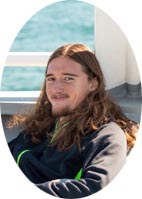
Christian Fender
Christian completed a Ph.D. in our lab in 2025. His research was focused on gelatinous zooplankton. He's pretty crazy about them. His research project is focused on salps of the Chatham Rise. He is using scanning electron microscopy and other approaches in an attempt to define the niche space of different salp species. He is also interested in pyrosomes and other pelagic tunicates. Christian is now teaching faculty at FSU. Contact: ckfender@fsu.edu

Heather Forrer
Heather completed a Ph.D. in 2024 as a member of both our lab and the Robert Spencer organic biogeochemistry lab. Heather's research cuts across disciplines as she investigates the intersections of the nitrogen and carbon cycles. She uses advanced FT-ICR-MS techniques for ultra-high resolution characterization of the organic matter contained in sinking particles. Contact: hforrer@fsu.edu
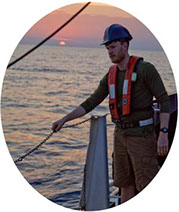
Tom Kelly
Tom completed his Ph.D. in the FSU Plankton Ecology and Biogeochemistry Lab in the fall of 2020. His research focuses on marine biogeochemistry and the application of such diverse tools as radioactive isotopes and inverse models to understanding the biological pump. Tom became one of the go-to members of our department for everything from computer programming to instrument engineering and biogeochemical modeling. He also logged several months at sea. Tom is now a researcher at the University of Alaska Fairbanks. Contact: tbkelly@alaska.edu
Taylor Shropshire
Taylor completed his Ph.D. in the FSU Plankton Ecology and Biogeochemistry Lab in summer of 2020. Taylor developed a three-dimensional model of ocean circulation and lower trophic level dynamics to model zooplankton in the Gulf of Mexico. He then developed an individual-based Lagrangian model of larval tuna and coupled it to his zooplankton model to simulate feeding, growth, starvation, predation, and survival rates of larval tuna in the oligotrophic regions in which they are spawned. He is using his model to address the impact of climate change on these organisms. Taylor is now a researcher at NC State University. Contact: tashrops@ncsu.edu
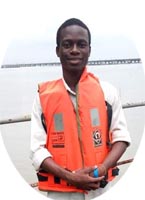
Opeyemi Kehinde
Opeyemi completed a masters degree in Oceanography related to the interactions between marine biogeochemistry and surface currents and winds. His research addressed the impact of meso- and submesoscale features in the ocean on the carbon and nitrogen cycles in the Indian Ocean spawning ground of Southern Bluefin tuna. His thesis was published in the Journal of Geophysical Research: Oceans. Contact: opeyemi.kehinde891@gmail.com
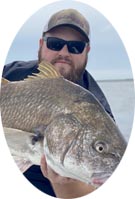
John Irving
John was a member of the modeling wing of our lab and split his time between the EOAS dept. and the Center for Ocean-Atmospheric Prediction Studies (COAPS). John's focus was on incorporating predation- and starvation-induced mortality into Lagrangian individual-based models of larval snapper in the Gulf of Mexico and Lagrangian modeling to estimate carbon sequestration temporal horizons in the Pacific Ocean. He defended his masters in 2022. Contact: jpi18@my.fsu.edu